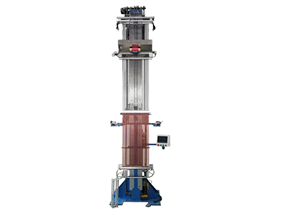
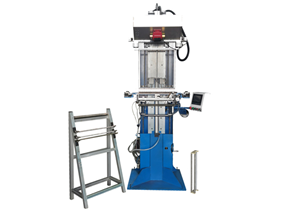
Air electric heater is a widely used type of heater, mainly used to heat gas flow. We commonly call it air electric heater, but it can be further divided into many types according to the different heating gases. Common ones include nitrogen heater and hydrogen heater. These can also be called pipeline gas heaters.
The heating element of the air electric heater is a stainless steel electric heating tube, and the heater chamber is equipped with multiple baffles (guide plates) to guide the flow of gas and prolong the residence time of gas in the chamber, so as to fully heat the gas, evenly heat the gas, and improve the heat exchange efficiency. The heating element of the air electric heater is a stainless steel heating tube, which is made by inserting electric heating wires into seamless steel pipes, filling the gaps with magnesium oxide powder with good thermal conductivity and insulation properties, and then shrinking the tube. When current passes through a high-temperature resistance wire, the heat generated diffuses towards the surface of the heating tube through crystalline magnesium oxide powder, and is then transferred to the heated air to achieve the purpose of heating.
The melt blown process requires a large amount of hot air. The compressed air output by the air compressor is dehumidified and filtered before being transported to the air electric heater for heating, and then sent to the melt blown die assembly. Air electric heaters are pressure vessels that must resist the oxidation of high-temperature air, so stainless steel must be used as the material. The heating element of the air electric heater is a stainless steel electric heating tube. Multiple baffles are installed inside the heater cavity to extend the residence time of air in the heater cavity and improve heat exchange efficiency. Appropriately increasing the number of heating tubes and increasing the installed power of the air electric heater can shorten the heating time of the production line during start-up. The melt blown process requires high temperature control accuracy for the stretching air electric heater, and the stretching air temperature needs to be stable within a range of ± 1 ℃.
The working principle of an air electric heater is to install a primary coil with more turns and a secondary coil with fewer turns on the same iron core. The ratio of input to output voltage is equal to the ratio of coil turns, while the energy remains constant. Therefore, the secondary coil generates a large current under low voltage conditions. For induction heaters, the bearing is a short-circuit single turn secondary coil that generates a large amount of heat by passing a high current under low AC voltage conditions. The heater itself and the magnetic yoke are kept at room temperature. Due to the induction of current by this heating method, the bearing will be magnetized. It is important to ensure that the bearings are demagnetized in the future so that they do not attract metal magnetic chips during operation. FAG induction heaters all have automatic demagnetization function. It is the use of metal to generate eddy currents in an alternating magnetic field to generate heat, usually used in metal heat treatment and other fields. The principle is that when thicker metals are in an alternating magnetic field, they will generate current due to electromagnetic induction. Thicker metals generate current, which forms a spiral flow path inside the metal. As a result, the heat generated by the current flow is absorbed by the metal itself, causing it to quickly heat up.
Uniformly distribute high-temperature resistance wires inside the seamless stainless steel tube, and densely fill the gaps with crystalline magnesium oxide powder with good thermal conductivity and insulation properties. This structure is not only advanced and has high thermal efficiency, but also generates uniform heat. When current passes through the high-temperature resistance wire, the heat generated diffuses to the surface of the metal tube through the crystalline magnesium oxide powder, and is then transferred to the heated element or air, achieving the purpose of heating. Air electric heaters are mainly used to heat the required airflow from the initial temperature to the desired air temperature, up to a maximum of 850 ℃. It has been widely applied in many scientific research and production laboratories such as aerospace, weapons industry, chemical industry, and higher education institutions. Especially suitable for automatic temperature control and high flow high-temperature combined systems and accessory testing. Air electric heaters have a wide range of applications: they can heat any gas, producing hot air that is dry, moisture free, non-conductive, non combustible, non explosive, non corrosive, non polluting, safe and reliable, and heats up the heated space quickly (controllable).
The advantages of air heaters are
1. It can heat the air to a very high temperature, up to 450 ℃, while the shell temperature is only around 50 ℃;
2. High conversion efficiency: up to 90% thermal energy conversion rate;
3. The heating and cooling rate block can reach 10 ℃/S, with fast and stable adjustment. It will not cause temperature control drift due to the phenomenon of controlled air temperature leading or lagging, making it very suitable for automatic control;
4. Good mechanical performance: Because its heating element is made of specially made alloy material, it has better mechanical performance and strength than any heating element under the impact of high-pressure air flow. This is more advantageous for systems and accessory tests that require long-term continuous air heating;
5. Durable and long-lasting, with a lifespan of several decades, without violating usage regulations;
6. The air is clean and the volume is small.