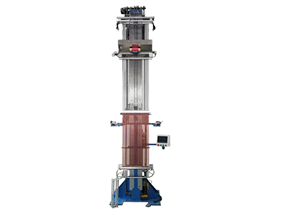
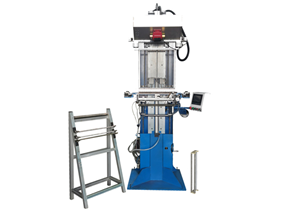
Thermal oil heater: It uses coal, heavy oil, light oil, combustible gases, and other combustible materials as fuel, with thermal oil as the heat carrier. The use of a circulating oil pump to forcibly circulate the liquid phase, delivering thermal energy to the heating equipment and then returning it to the reheated DC special industrial furnace. Thermal oil, also known as organic heat carrier or heat medium oil, has been used as an intermediate heat transfer medium in industrial heat exchange processes for over fifty years.
Thermal oil heater, also known as thermal oil temperature controller, hot oil temperature control device, oil heating temperature controller, or thermal oil electric heater, is a large-scale thermal oil temperature control device that can heat the thermal oil temperature to 350 degrees Celsius at lower operating pressures. It has a large pump flow rate and high heating power.
Thermal oil electric heater is a new, safe, efficient and energy-saving special industrial furnace that can provide high-temperature heat energy at low pressure (normal pressure or lower pressure). It uses thermal oil as the heat carrier, circulates the heat carrier through a hot oil pump, and transfers heat to the heating equipment.
The electric heating thermal oil furnace system consists of an explosion-proof electric heater, organic heat carrier furnace, heat exchanger (if any), on-site explosion-proof operation box, hot oil pump, expansion tank, etc., which are combined into one pry block. Users only need to connect the power supply, medium inlet and outlet pipelines, and some electrical interfaces to use it.
The thermal oil heater is a complete circulating heating system formed by directly inserting an electric heater into an organic carrier (thermal oil) for direct heating, and using a high-temperature oil pump for forced liquid-phase circulation to transport the heated thermal oil to the heating equipment, and then returning it to the hot oil furnace for heating from the outlet of the heating equipment. The thermal oil heater adopts a digital temperature controller for temperature control, with functions of over temperature alarm, low oil level alarm, and over pressure alarm. It is an efficient and energy-saving heating equipment in industries such as chemical, textile, printing and dyeing, food, plastic, and film.
The working principle and process of thermal oil heater. For the principle of the heat transfer oil heater: We emphasize that heat is generated and transmitted by the electric heating element immersed in the heat transfer oil. Using the heat transfer oil as the medium, a circulation pump is used to force the heat transfer oil to circulate in the liquid phase, transferring the heat to one or more heating devices. After unloading the heating devices, the heat is returned to the heater through the circulation pump, and then absorbed and transferred to the heating devices. This process repeats itself, achieving continuous heat transfer and raising the temperature of the heated object to meet the heating process requirements. Thermal oil heaters are mainly used in the petroleum and chemical industry, oil and fat industry, synthetic fiber industry, textile printing and dyeing work, non-woven industry, feed industry, plastic and rubber industry, paper industry, etc.
The advantages of a thermal oil heater are:
1. Fast heating speed, high heat transfer efficiency, and less prone to scaling.
2. Can heat oil products quantitatively, heating as much as needed.
3. The oil will not experience local high temperature or carbonization, ensuring the quality of the oil and the heat transfer efficiency of the heater.
4. The temperature at the outlet of the oil tank is the highest, ensuring the fluidity of the poured oil.
5. Avoiding repeated heating of the oil in the tank ensures the color of the oil and reduces the cost of oil treatment.
6. Long service life, corrosion resistance, high temperature resistance, high pressure resistance, and anti scaling function greatly improve the overall performance of the heat exchanger.
7. The advanced design of the process structure ensures the smooth flow of oil products and a good "bottom pumping" effect.
8. Automated control can be achieved, and the steam feed rate can be controlled based on the inlet and outlet temperature of the oil and the oil flow rate.
9. Compact structure, easy installation and maintenance, will not affect the safety of the tank due to the installation of the heater. Compared with U-tube heat exchangers, under the same heat transfer area, the external dimensions of vortex heat film heat exchangers are only about half of those of U-tube heat exchangers.
10. Compared to electric heating methods, it is safer, heats more gently, and has less impact on oil quality.